Installation
When Installing This Product...
-
Read these instructions carefully. Failure to follow them could damage the product or cause a hazardous condition.
-
Check the ratings given in these instructions to make sure the control is suitable for your application.
-
Installer must be a trained, experienced service technician.
-
After installation is complete, check out operation as provided in these instructions.
-
If the control module is continuously powered, resetting it or exiting lockout mode requires removing the 24VAC power source (turning it OFF), then restoring it (turning it ON). However, if the thermostat supplies the 24VAC power, you can reset the control module and exit lockout mode by adjusting the thermostat setting below room temperature. Wait one minute, then raise the setting to call for heat. This manual assumes that the thermostat is the source of 24VAC power to the control module.
Important:
If this is a replacement application, follow the appliance manufacturer's instructions if available.

|
WARNING: FIRE OR EXPLOSION HAZARD Can cause severe injury, death or property damage.
|
|
|
WARNING: Electrical Shock Hazard Can cause severe injury, death or property damage. Disconnect power supply before beginning wiring or making wiring connections to prevent electrical shock or equipment damage. |

|
CAUTION
|
|
|
CAUTION: EQUIPMENT DAMAGE HAZARD Water can cause equipment damage or malfunction. If the module must be mounted near water or moisture, provide suitable waterproof enclosure. |
Maintenance Requirements in Severe Environments
Regular preventive maintenance is important in any application.
|
|
WARNING: Fire or Explosion Hazard May cause severe injury, death or property damage. Do not attempt to take the module apart or to clean it. Improper reassembly and cleaning may cause unreliable operation. |
Maintenance frequency must be determined individually for each application. Some considerations are:
-
Cycling frequency. Appliances that may cycle more than 20,000 times annually should be checked monthly.
-
Intermittent use. Appliances that are used seasonally should be checked before shutdown and again before the next use.
-
Consequence of unexpected shutdown. Where the cost of an unexpected shutdown would be high, the system should be checked more often.
-
Dusty, wet, or corrosive environment. Since these environments can cause the modules to deteriorate more rapidly, the system should be checked more often.
Any module should be replaced if it does not perform properly on checkout or troubleshooting. In addition, replace any module if it is wet or looks like it has ever been wet. Protective enclosures as outlined under “Planning the Installation” are recommended regardless of checkout frequency.
Location
The mounting location must provide:
-
Good, clear access to the field wiring terminals.
-
Operating ambient temperatures between -40°F and 175°F (-40°C and 79°C).
-
Relative humidity below 95% noncondensing.
-
Protection from water, steam or corrosive chemicals that are used to clean the appliance.
-
Protection from dripping water, such as from an overfilled humidifier or from condensation.
-
Protection from dust or grease accumulation.
Mount the Ignition Module
Select a location close enough to the burner to allow a short (3 ft. [0.9 m] max.), direct cable route to the
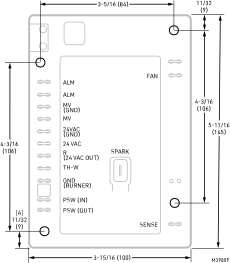
The S8701 may be mounted in any position. See Recommended Mounting Pattern diagram for mounting hole locations.
Fasten securely with at least two No. 6-32 machine screws or No. 8 sheet metal screws using the mounting holes diagonally across from each other.
Mount the System Controls
Mount any required controls, such as the gas control, spark igniter, flame sensor, thermostat, limit, and transformer according to manufacturer’s instructions.
Wire the System
|
|
CAUTION: EQUIPMENT DAMAGE HAZARD Disconnect power supply before beginning wiring or making wiring connections to prevent electrical shock or equipment damage. |
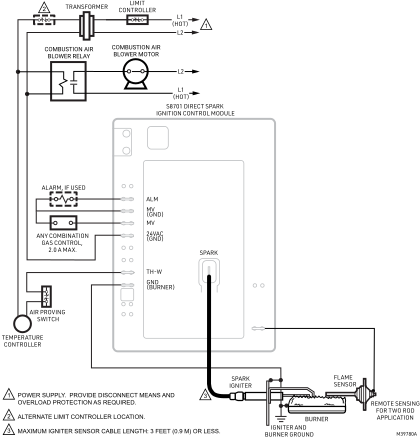
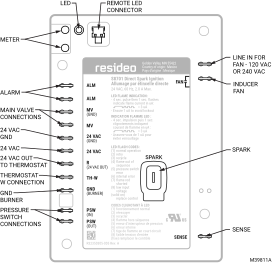
All wiring must comply with local codes and ordinances. See Ignition Module wiring connection locations (Model S8701 shown) for proper wiring connections.
Important:
-
As shown in the wiring diagrams, a common ground is required on:
-
The burner mounting bracket, and
-
The GND (BURNER) terminal on the ignition module.
-
-
Make sure the transformer has adequate VA. The ignition module requires at least 0.2 A at 24 Vac. Add the current draws of all other devices in the control circuit, including the main gas control and alarm, and multiply by 24 to determine the total VA requirement of these components. Add this total to 4.8 VA (for the ignition module). The result is the minimum transformer VA rating. Use a Class II transformer if replacement is required.
Connect Ignition Cable
Use Resideo ignition cable or construct an ignition cable that conforms to suitable national standards such as Underwriters Laboratories Inc. See Recommended Ignition Cable for Field Assembly.
|
CABLE TYPE |
VOLTAGE RATING (rms) |
TEMPERATURE RATING |
|---|---|---|
|
UL Style 3217 |
10,000 |
302°F (150°C) |
|
UL Style 3257 |
10,000 |
484°F (250°C) |
Cable must be no longer than 36 in. (0.9 m).
Note: The cable must not run in continuous contact with a metal surface or spark voltage will be greatly reduced. Use ceramic or plastic standoff insulators as required. Resistive spark cable reduces spark voltage and may impact appliance performance.
To install:
-
Connect one end of the cable to the male quick connect SPARK terminal on the ignition module.
-
Connect the other end of the cable to the igniter.
Connect Ignition Module
Note: Refer to Ignition Module wiring connection locations (Model S8701 shown) and see Wiring Connections for the location of each connection.
Connect remaining system components to the ignition module terminals as shown in the appropriate wiring diagram.
Connect Gas Control
Use 18-gauge solid or stranded wire. Use female quick connects for module connections. Connect to gas control terminals as shown in wiring diagrams, using terminals appropriate to the gas control.
Grounding S8701, Spark Igniter, and Main Burner.
For the system to operate properly, the
-
Fit one end of the ground wire with a female 1/4 in. quick-connect terminal and connect it to the male quick-connect GND (BURNER) terminal on the S8701 control module.
-
Strip the other end of the wire and fasten it under the igniter bracket mounting screw. If necessary, use a shield to protect the ground wire from radiant heat. The burner serves as the common grounding area.
Note: While earth grounding of the burner is not required for the proper operation of this module, it is strongly recommended. Grounding may be required by the appliance manufacturer or by local electrical codes to ensure safety, reduce electrical noise, and prevent potential damage. Always consult the appliance documentation and applicable regulations before installation.
Ignition Module wiring connection locations (Model S8701 shown)
|
Connector Name |
Size |
Description |
|---|---|---|
|
ALM |
1/4 inch |
Alarm Terminals a |
|
ALM |
1/4 inch |
|
|
MV |
3/16 inch |
Main Valve Connection |
|
MV (GND) |
1/4 inch |
Common terminal for Main Valve Connection |
|
24 VAC |
1/4 inch |
24 VAC Power in (for direct power for post purge) |
|
24 VAC (GND) |
1/4 inch |
24 VAC Return path to transformer (Same connection as MV (GND)) |
|
TH-W |
1/4 inch |
Thermostat W wire connection |
|
R (24 VAC OUT) |
1/4 inch |
24 VAC Power Out to thermostat (if 24V AC direct power) |
|
GND (BURNER) |
1/4 inch |
Burner Ground |
|
PSW (IN) |
1/4 inch |
24VAC Pressure Switch input |
|
PSW (OUT) |
1/4 inch |
24 VAC Output to Pressure Switch |
|
FAN |
1/4 inch |
Line in for fan - 120 Vac or 240 Vac |
|
FAN |
1/4 inch |
Inducer Fan |
|
SPARK |
1/4 inch |
High Voltage Spark Electrode |
|
SENSE |
3/16 inch |
Flame Sensor for 2 rod remote sensing applications |
|
Meter Connections |
|
Volt meter connections for reading flame current |
|
Remote LED |
Molex 26-60-4020 |
Pulses voltage in sync with LED flashes. Mating connector is Molex 26033021. |
Not all models have all terminals.
a There are two configurations for the alarm:
-
If two terminals are present, it is a dry contact configuration. You need to provide power to either terminal. The other terminal will serve as the signal.
-
If only one terminal is populated, the alarm signal will output 24 VAC when active. Power is supplied internally in this configuration.
S8701 Connection Wiring Diagram
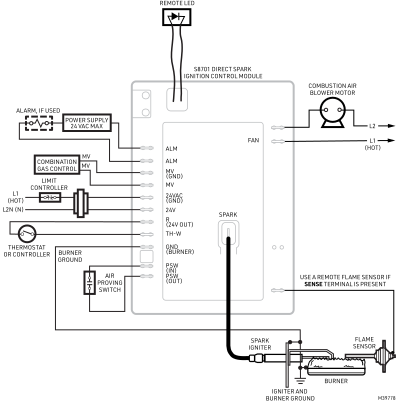
S8701 Wiring Diagram
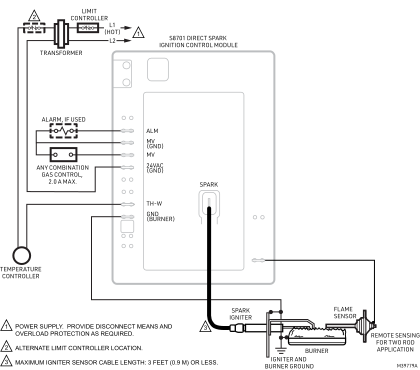
S8701 Wiring Diagram (with external fan connection)